Civil Records
Civil (vital) registration began in Ireland on the 1st April 1845. However, it was only partial registration, recording non-Catholic Christian, Jewish and civil marriages. It had been the government’s intention to provide for registration of Catholic marriages too, but the Catholic authorities refused to allow “interference” with its internal affairs.
Full civil registration began on the 1st January 1864, from which time there was a legal requirement to register all births, deaths and marriages. Access to Ireland’s civil records is through the series of annual indexes compiled since 1845.
Quick links
General Register Office of Ireland
General Register Office of Northern Ireland
Access to Indexes and Records
Birth Records
Marriage Records
Death Records
Obtaining Records
General Register Office of Ireland (GROI)
At this time only hardcopies of the index volumes can be consulted at GROI. There are no computers to facilitate swifter searches. Its holdings cover all of Ireland from 1st April 1845, but relate only to the Republic of Ireland from 1st January 1922. Historic records covering births registered more than 100 years ago, marriages more than 75 years ago and deaths more than 50 years ago are available here. As of 2021, deaths from 1864-1870 are not accessible on this site and must be ordered from the GROI.
General Register Office of Northern Ireland (GRONI)
A computerised database of indexes and scanned images (covering all records from 1st January 1922) can be seen at the General Register Office of Northern Ireland (GRONI). Online access to ‘historic’ registration records is also available for births registered more than 100 years ago, marriages more than 75 years ago and deaths more than 50 years ago, see here.
The period 1845 to 1921 missing from GRONI records has been filled by centralising the registers held by each of the local registration offices from across Northern Ireland. However, caution is required given that in border areas Registration Districts crossed county boundaries and thus some pre-1922 Northern Irish records fall into registers retained by registration offices south of the border.
Access to Indexes and Records
The following information is provided in addition to that already given above. In the late 1950s, the series of annual indexes created by the General Register of Ireland were microfilmed for the years 1845-1958 (with a few very small gaps) by the Church of Latter Day Saints (LDS) – now FamilySearch. The data captured on these films has been digitised by FamilySearch and can be searched on its website. This data has also been shared by FamilySearch with Ancestry.com and Findmypast.ie. Researchers should also note that the LDS also holds some microfilm copies of the civil registers of births, deaths and marriage and that those relating to births for the period 1864 to June quarter 1881 have been transcribed and added to the FamilySearch website, see here. The State-sponsored Irish Genealogy put up an “enhanced” version of the same index records, but they are limited to births over 100 years ago, marriages over 75 years ago and deaths over 50 years. Mother’s maiden names are included in this index from approx 1900 onwards.
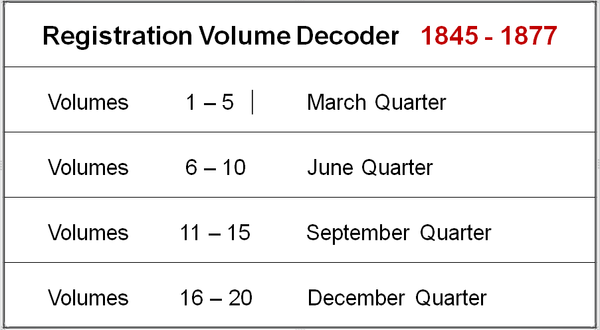
The LDS also filmed both the annual indexes and the civil registers held by GRONI for the years 1922-1959. However, due to contractual reasons these have not been added to the FamilySearch website.
Some of the county-based genealogy heritage centres have also been allowed access to locally held civil registers. Where this has been the case, the information therein contained has been transcribed into a searchable database. However, rarely do these go past approximately 1922. See here for more information.
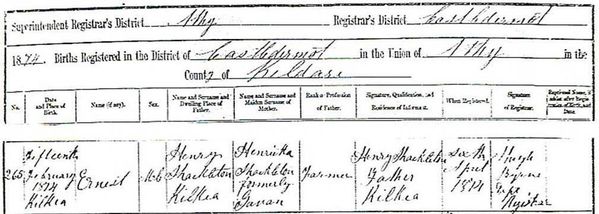
Birth Records
Birth records note the child’s date and place of birth, first name(s), parents’ names and address and the name and address of the informant. Under later legislation in the Republic of Ireland, principally the Civil Registration Act 2004, further information was added, noting the date of birth of both parents and their mothers' maiden surname.
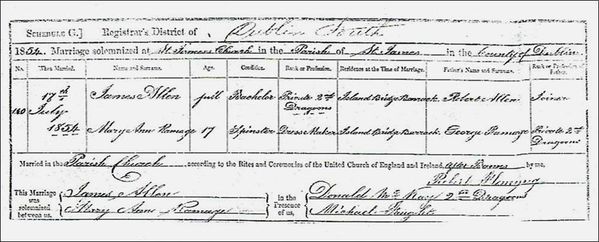
Marriage Records
Marriage records note the date and place of the marriage, each party’s name, age, occupation, marital status, address, father’s name & occupation and the names of at least two witnesses. In the Republic, from 1956 both parties' dates of birth are recorded and both parents’ names. In Northern Ireland, both parents’ names are recorded from 2007. It is worth noting though that too often Irish civil marriage records note the parties’ ages as either “full age” or “minor” (under or over 21 years of age).
Death Records
Death records are the least informative. They note the deceased’s date and place of death, name, age, occupation, marital status, address and the name and address of the informant. In Northern Ireland, from 1973 the deceased’s date and place of birth are recorded and the maiden surname of a married woman. Further, from 17th December 2012, the deceased’s parents’ names are noted too.

In the Republic, under the Civil Registration Act 2004, the deceased’s date & place of birth and parents’ names are noted from 5 December 2005.
Obtaining Records
Throughout Ireland and Northern Ireland civil records are public records and there are no restrictions on the obtaining copies of them. At this time, GROI (Republic) provides free access (within the data protection parameters through Irish Genealogy. GRONI does the same but charges for access. Copies of records can be obtained either in person, by phone or written application. See links above to relevant websites. In the Republic, uncertified (or plain) copies of register entries can be obtained for €5. These note exactly the same information as a certificate, which cost €20. In Northern Ireland, certificates are supplied at a cost of £15 (+ postage); no uncertified copies of registers are made available.